
Finding a lesion in a bone is frightening. The first thing worth knowing is that most bone tumors are benign: they are not cancer, they do not spread, and many never need surgery at all.
The second is that telling a benign lesion from a malignant one is not settled by an X-ray or by what you read online. It is settled with the right imaging and, when necessary, with a biopsy taken at the right moment and in the right place.
This page explains how a bone lesion is worked up, what is done here and what is not, and when the right answer is not to travel but to be seen quickly where you are.
When not to wait
Some bone complaints can be looked at calmly and some cannot. If any of these sound like you, get assessed soon — with us or with the orthopedic surgeon closest to you:
- Bone pain that appears or worsens at night and does not ease with rest.
- A lump or mass that is growing, especially if it is firm and fixed to the bone.
- A fracture that happened with a minor injury, or with none at all.
- Pain that persists at rest, not only with movement or weight.
- A finding on an X-ray taken for another reason, described as a bone lesion of unclear cause.
Not every bone tumor is cancer
Benign tumors are the majority. They grow slowly, stay where they are, and do not invade other tissue. Some are found by chance on an X-ray and need nothing but watching. Others cause pain, weaken the bone or deform it, and then they are operated on: the lesion is removed and the defect is filled or reconstructed. Among the most common are osteochondroma, enchondroma, bone cyst and giant cell tumor.
Malignant tumors are uncommon. They can start in the bone — osteosarcoma, chondrosarcoma, Ewing sarcoma — or arrive from another organ, which is the more frequent situation in adults and is called bone metastasis. Here treatment is rarely surgical alone: it usually combines surgery with chemotherapy or radiation, and it is decided by a team, not by one doctor.
A malignant lesion does not mean losing the limb. Most cases today are treated with limb salvage surgery: the tumor is removed with a margin and the bone is reconstructed. Whether that remains possible depends in large part on how the first step of the diagnosis was handled.
How a bone lesion is worked up
- 1
History and physical exam
How long it has hurt, how it hurts, whether there is a mass, whether there was an injury, what your background is. It tells more than people expect.
- 2
X-ray
The first study and often the most informative. Several benign lesions have an appearance characteristic enough that nothing beyond follow-up is needed.
- 3
MRI or CT
When the X-ray is not enough, these define the true extent of the lesion, which tissues are involved, and whether there is anything the X-ray did not show.
- 4
Biopsy
This is what gives the definitive diagnosis. Not every lesion needs one; when one is needed, it is the step that determines everything that follows. If you have already had a biopsy elsewhere, bring it with its slides and its report: it is not repeated out of habit, it is reviewed.
Who handles these cases
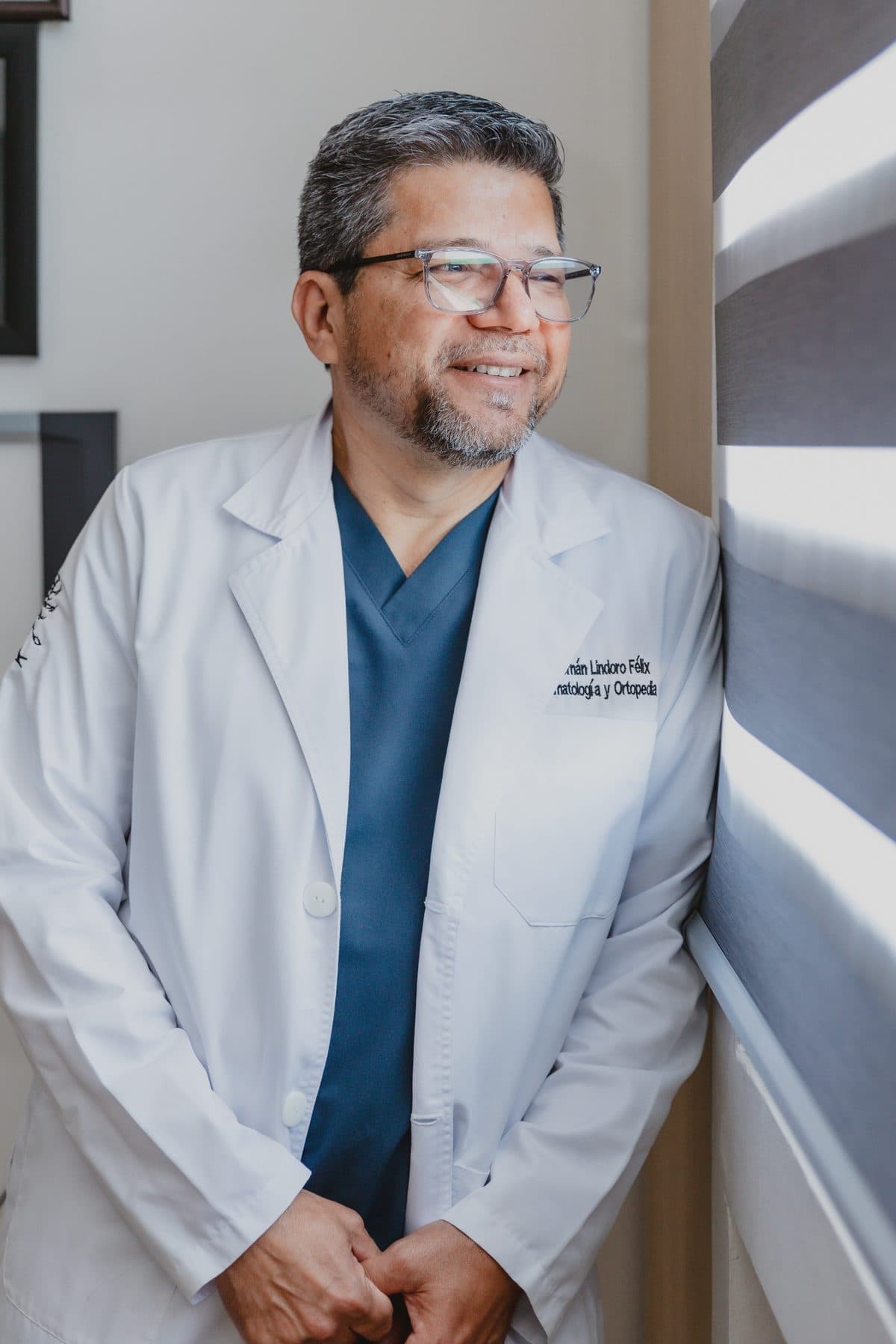
Bone tumor cases within the Medical Group are handled by Dr. Hernán Lindoro Félix: reconstruction and orthopedic oncology.
- Medical Doctor (Médico Cirujano), Universidad Autónoma de Sinaloa.
- Residency in Orthopedics, IMSS, Centro Médico Nacional del Noroeste.
- Diploma in Limb Salvage and Reconstruction in Orthopedic Oncology — UNAM, School of Medicine, organized by the Instituto Nacional de Rehabilitación. April 2011 to February 2012, 1319 in-person hours (1056 practical).
- Cédula de especialidad (professional license) DGP 5575849 · Cédula de médico cirujano DGP 3841775.
Procedures performed in Tijuana
- Planned biopsy, through an approach that does not compromise the definitive surgery.
- Curettage of the lesion and filling of the defect.
- En bloc resection with margin.
- Reconstruction with a tumor prosthesis.
- Reconstruction with graft or allograft.
- Limb salvage surgery.
- Stabilization of a pathological fracture.
- Surgery for bone metastases, including stabilization for pain control.
- Amputation, when limb salvage is not possible.
What is not done here
Chemotherapy and radiation are not given by an orthopedic surgeon. A malignant bone tumor is treated across several specialties — medical oncology, radiation oncology, pathology and orthopedic oncologic surgery — working on the same case.
When your case needs that full team, one of two things happens. If it can be coordinated here, we explain with whom and how. If what suits you is a referral cancer center, we say so and help you get there, with your studies organized and a summary of what we found.
We are not going to hold on to a case that is better treated somewhere else. That is not a disclaimer: it is the reason you can trust what we do propose.
If you are coming from abroad
A benign bone tumor does fit a short trip: it is assessed, it is operated on, and you go home, with remote follow-up afterward.
A malignant tumor is a different matter, and it is worth saying before you arrange anything. Treatment can run for months, chain several phases, and require you to stay close to the team treating you. Planning a few days' trip for that can cost you time that matters.
If you suspect your case is malignant, the useful step is not to book a trip: it is to write to us. We review what you already have and tell you frankly what we see, whether it makes sense for you to come and, if it does not, what kind of center you should look for where you live.
Write to us and we will review your case
If you already have X-rays, an MRI, a CT scan or a biopsy report, Dr. Lindoro can review them. Write to us first with your contact details: we will reply and open a secure channel for you to send them. If you do not have studies yet and you recognize yourself in the signs above, write anyway and we will tell you which ones to start with.
Do not send studies or describe your case in this first message. We ask for the minimum needed to reach you, deliberately: your clinical information should not travel over an open channel.